ChinaTravelChinachinatravelchina.comPlan a trip
White and blue CRH Hexie Hao high-speed train at a covered station platform, with yellow tactile paving and people waiting nearby

Beijing to Shanghai High-Speed Train

Direct high-speed trains link Beijing South and Shanghai Hongqiao in about 4.5–6 hours — check live times and prices before you book.

Typical duration
About 4.5–6 hoursFastest: About 4.5 hours on the fastest services
Average fare

1st class

¥967–1,115

US$144–166

2nd class

¥576–697

US$86–104

Main stations
Beijing South → Shanghai Hongqiao
Service
Direct high-speed services

Tickets are sold by China Railway (12306) — guide to official purchase channels. This page does not show live seat availability. Editorial review: 10 November 2026 (not a live fare check).

Kit quick-facts graphic (dated example). The accessible summary above uses verified route data. The second-class ¥553 figure shown in this graphic is a G547 / Ctrip sample for 10 November 2026 — not the Average fare columns, which use TravelChinaGuide G-train daytime ranges. Dated kit example — not a live quote.

Journey times

Planning estimates only — not a live timetable. Exact times depend on the train you book.

MeasureEstimateNote
TypicalAbout 4.5–6 hoursMost G-series planning bands
FastestAbout 4.5 hours on the fastest servicesLower end of the demo band
DistanceAbout 1,318 kmCatalog reference figure

Ticket prices

Indicative orientation only. Live fares and seats come from China Railway (12306), not this page.

Seat classChineseNotes
Second class二等座Most common class for this corridor. Price varies by train and date — confirm live.
First class一等座Wider seat than second class. Availability depends on the train.
Business class商务座Highest class when offered. Not every train has it.
ClassIndicative (¥)Indicative (USD)
1st class¥967–1,115US$144–166
2nd class¥576–697US$86–104

ChinaTravelChina does not invent ¥ or USD amounts or show fake availability — confirm live prices on the booking provider before you buy. Fare source and as-of date are in the FAQs below.

Illustrated typical seat layouts: second class A B C, aisle, D F; first class A C, aisle, D F; a common business-class layout A C, aisle, F. Layouts vary by train. Fare examples in the graphic are dated and not live prices.
Original diagrams of common layouts, not exact carriage plans. Price callouts in this graphic are dated G547 / Ctrip samples for 10 November 2026 — use the Average fare table above for indicative ranges. Dated kit example — not a live quote.
Typical second-class seat letters: A and F are windows; C and D are aisle seats; B is the middle seat. Diagram is illustrative; check the selected train layout.
Typical second-class seat lettering. Confirm the layout of your selected train.

Opens China Railway (12306) via guide to official purchase channels.

Check trains & prices

Which stations should you use?

Many high-speed trains on this route run between Beijing South (北京南站 · VNP) and Shanghai Hongqiao (上海虹桥站 · AOH). Beijing West and Shanghai Railway Station also appear for other products — always match the station printed on your ticket, not a generic city name. Telegraph codes (VNP / AOH / SHH) help when a booking UI shows English and Chinese labels inconsistently.

Usual departure station

Beijing South

北京南站 · code VNP

Most G-series Beijing–Shanghai planning notes in our catalog start here. Booking “Beijing” without a station can land you at a different terminal with a costly same-city hop. Prefer lodging or metro plans that treat 北京南站 as a named place, not as “downtown Beijing.”

Getting onward

Metro Lines 4 / 14 serve many central hotels (editorial orientation from the city getting-there page). Allow buffer for security. We do not publish verified walk times or last-train guarantees — check metro maps locally on travel day.
Getting to and from Beijing →

Usual arrival station

Shanghai Hongqiao

上海虹桥站 · code AOH

Pairs HSR with Hongqiao Airport and metro Lines 2 / 10 / 17 — useful for Yangtze Delta continues. Arriving at Shanghai Railway Station instead changes hotel and airport transfers entirely. Hongqiao is a large multi-modal complex; plan arrival patience, not a sprint to a meeting.

Getting onward

Hongqiao complex wayfinding takes time at peaks. Airport adjacency is for SHA-side flights, not a PVG substitute. See Shanghai getting-there for airport vs station orientation. Maglev / PVG links are separate products — never assume through-check from HSR.

Getting to and from Shanghai →

Alternative in Shanghai

Shanghai Railway Station

上海站 · code SHH

Catalog alternate in Shanghai — some services use 上海站 (SHH). Do not assume your G-train stops here; trust the ticket. Useful when a hotel is nearer the historic station belt, but only if the train actually lists SHH.

Getting onward

If you arrive Hongqiao and later depart Shanghai Railway Station (or reverse), treat that as an inter-station metro/taxi connection with its own buffer — not an automatic transfer. Luggage and peak crowding make “tight same-evening” connections risky; we do not publish verified minutes.

Getting to and from Shanghai →

Alternative in Beijing

Beijing West

北京西站 · code BXP

Major Beijing hub for other corridors (e.g. many Xi’an services). Not the seeded primary for Beijing–Shanghai HSR in this catalog. Mixing West-oriented hotel plans with a South departure is a classic first-trip error.

Getting onward

If a booking UI offers Beijing West for a Shanghai train, verify the train number on an official channel before you rely on hotel transfer plans built around South. West remains the planning default on our Beijing–Xi’an corridor page instead.

Getting to and from Beijing →

The right station matters

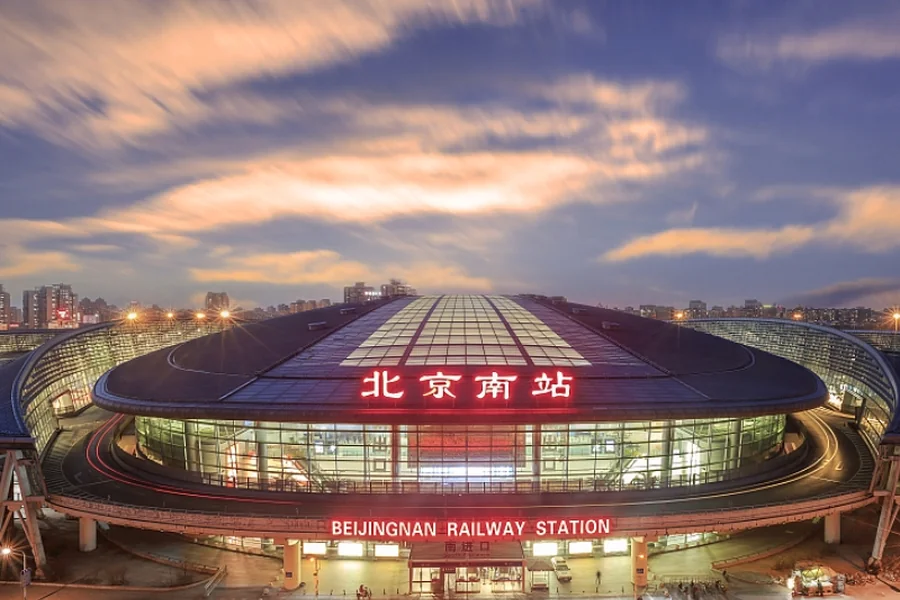
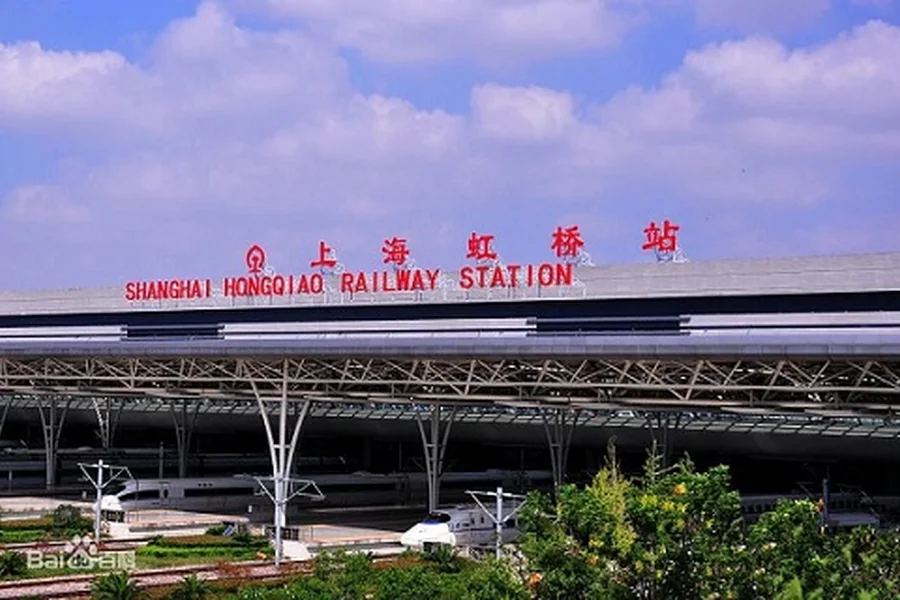
Match the full station name on your booking — entrance photos of the usual departure and arrival terminals on this corridor.

Dusk exterior of Beijing South Railway Station (北京南站 / Beijingnan), glass façade and illuminated South Entrance signs.
Beijing South (北京南站)Beijing South (北京南站) — usual departure station on this corridor.
Exterior of Shanghai Hongqiao Railway Station (上海虹桥站), curved glass façade and plaza approach.
Shanghai Hongqiao (上海虹桥站)Shanghai Hongqiao (上海虹桥站) — usual arrival station on this corridor.
Static geographic map following the Beijing–Shanghai high-speed railway from Beijing South through Tianjin South, Jinan West, Xuzhou East, Bengbu South and Nanjing South to Shanghai Hongqiao. Selected stations are shown; stops vary by train.
Main Jinghu railway alignment; selected stations only. Check the stops and terminals on your booking. Map shows corridor alignment, not a specific train’s stop pattern. Map data © OpenStreetMap contributors, ODbL 1.0. Base geography: Natural Earth, public domain.

How to book

Buy from China Railway (12306). ChinaTravelChina does not sell tickets.

How to plan your journey

  1. Pick your stations and dates

    Match Beijing South ↔ Shanghai Hongqiao when that pair fits your hotels — or another printed terminal. Duration on this page is a demo band (~4.5–6 h), not a timetable.

    Which stations should you use? →

  2. Sketch the trip with site tools

    HSR map for schematic city placement, rail explorer for corridor compares, station finder for EN/ZH/code, budget preset for sample stay math — all demo-labeled. Then leave this site to buy.

    Before you book →

  3. Buy on official channels

    Use 12306 / railway counters / listed agencies. Passport and real-name rules apply; ChinaTravelChina does not sell tickets.

    How to buy train tickets as a foreigner →

  4. Get to the station early

    Security, gates, and seat-class orientation live on the first-time HSR guide — keep purchase and ride-day topics separate.

    First-time high-speed rail guide →

  5. Continue from your arrival station

    Plan metro/airport hops from the exact station on your ticket. Same-city station changes are separate connections, not through-tickets. Short Delta continues (Hangzhou, Suzhou, Nanjing) are separate corridor pages.

    Getting around from Shanghai’s stations →

An original illustrative booking card, not a real ticket or a provider screenshot. Check departure and arrival station names, travel date, train number, carriage and seat, and passenger details matching the booking ID.
Teaching illustration only — fictional booking card, not a Trip.com / 12306 screenshot and not a travel document.

How to buy train tickets as a foreigner →·First-time high-speed rail guide →

Booking channel: China Railway (12306).

Check trains & prices

Train vs flight

Times and prices here are estimates for comparison, not live data.

ModeTimePriceFrequency
G-series high-speed (demo)~4.5–6 h (demo)Demo band only — not a live fareMultiple daily services (verify live)
Flight PEK/PKX → PVG/SHA (demo)~2.5 h air time + airport process (demo)Demo band only — not a live fare—
Illustrative door-to-door comparison using assumed city-center transfers: train totals 6 hours 30 minutes; flight totals 6 hours 45 minutes. These are planning examples, not measured averages or live schedules.
Illustrative planning assumptions only (not measured door-to-door averages): train 30 + 45 + 270 + 45 = 390 minutes; flight 60 + 120 + 135 + 30 + 60 = 405 minutes. Replace with your actual itinerary.

Getting to and from the stations

  • Same-station continue: staying inside Beijing South or Hongqiao for a later train is still a new boarding — re-check gate and train number; it is not an automatic through-ticket.
  • Inter-station transfer: arriving Hongqiao and departing Shanghai Railway Station (or Beijing South ↔ Beijing West) is a separate metro or taxi hop with luggage and peak-hour risk — plan buffer; we do not publish verified connection minutes.
  • Beijing South connects to metro Line 4 / Line 14 for many central hotels; allow buffer for security screening before departure.
  • Shanghai Hongqiao pairs HSR with Hongqiao Airport and metro Lines 2 / 10 / 17 — useful when continuing within the Yangtze Delta, but wayfinding takes time at peak hours.
  • Airport ↔ HSR is almost never through-checked. Treat air and rail as separate tickets unless an official product explicitly connects them.
  • After Shanghai, short Delta HSR pages (Hangzhou, Suzhou, Nanjing) are continues — open those corridor pages rather than inventing same-ticket assumptions from this Jinghu hop.

Passport and boarding requirements

Bring the original ID used to book. Station steps are orientation — follow live signs and staff.

  • Passport / ID must match the real-name ticket at gates — see the 12306 English FAQ (accessed 2026-11-09; re-open before travel) for English-site passport rules; nationality and channel still matter.
  • Common seat-class labels travelers see include second class (二等座), first class (一等座), and business class (商务座). Availability and naming vary by train product; this site does not quote live class prices.
  • E-ticket / QR / ID-gate flow depends on the channel and document used at purchase — follow the instructions on your official ticket order. Ticket collection at machines/counters is only required when your channel says so; do not invent workarounds.
  • Ride-day security and platform walks: first-time HSR guide. Purchase failures and payment limits: foreigners ticket guide.
  • Carry the same passport used at purchase. Screenshot or offline order details help when mobile data is patchy at the station — still follow official gate instructions over any third-party tip.
Six illustrated steps: bring your original booked passport, clear station security, find your train on the departure board, go to its gate, find your carriage and seat, and keep your ID ready for exit.
General process based on 12306 and Beijing government guidance. Follow current station signs and staff instructions.

Before you travel

Planning notes after the core facts — corridor role, tools, and honesty limits.

Where this route fits in a trip

Beijing–Shanghai is the visitor spine between the political capital and the Yangtze Delta commercial hub. In this catalog it is the longest, densest north–south high-speed city pair we treat as a flagship: use it when a trip needs both imperial-museum days in Beijing and Bund / French Concession time in Shanghai without treating the hop as a tour product. Catalog reference distance is about 1318 km — a planning figure, not a live surveyed claim for today’s trains. Typical-duration copy elsewhere on this page is a demo band (~4.5–6 hours depending on service), not a timetable. Neighbor corridors (Shanghai–Hangzhou, Shanghai–Suzhou, Shanghai–Nanjing) are short Delta continues after you arrive; Beijing–Xi’an is a separate heritage axis out of Beijing West, not a substitute for Jinghu station planning.

Choose the station before the hotel

Seeded primary ends for this corridor are Beijing South (北京南站 · VNP) and Shanghai Hongqiao (上海虹桥站 · AOH). Alternates in the city catalogs — Beijing West (北京西站) and Shanghai Railway Station (上海站 · SHH) — matter for other products or occasional services; they are not interchangeable with “Beijing” or “Shanghai” as city-level shortcuts. Station choice rewires metro lines, hotel transfer time, and whether Hongqiao Airport (SHA) is adjacent. Always match the exact pair printed on your ticket. Station cards below stay editorial orientation; which train uses which terminal today remains unknown here until you confirm on an official railway channel.

Planning tools for this trip

Use the schematic HSR map to place Beijing and Shanghai in the visitor-city graph — pins and straight lines, not official track geometry. Open Rail explorer when you want side-by-side corridor compare tables (duration bands stay demo-labeled). Station finder is for EN/ZH/code lookup against the seeded catalog, not live platform boards. The budget calculator’s Beijing–Shanghai weekend preset sketches stay costs with a flat demo HSR hop amount — it is not a Jinghu fare quote and does not sell seats. None of these tools replace 12306 or station counters for purchase; they only orient planning before you buy on official channels.

What this page can and can’t tell you

ChinaTravelChina does not sell tickets and does not scrape live inventory. The Average fare columns show indicative G-train daytime seat ranges transcribed from TravelChinaGuide’s Beijing–Shanghai page (source “Last Update” Jul 7, 2026) — a planning band, not a live 12306 quote or a mean we calculated. Live seats, train numbers, and fares come only from official railway sales channels (start with the 12306 English FAQ cited in Sources — accessed dates are when we last opened the URL, not a fare-check stamp). EditorialReviewedOn covers station guidance, transfer notes, FAQs, and this planning prose; it is not “verified today” for fares. Third-party booking sites are outside railway customer-service coverage for ticketing problems per that FAQ language — we do not invent workarounds or partner CTAs that pretend otherwise.

FAQs

How long is Beijing–Shanghai by high-speed rail?

Our catalog shows a demo estimate of about 4.5–6 hours depending on service. That is an illustrative planning band (claim status: estimate), not a verified timetable. Check live schedules on official railway channels before you travel.

Which stations should I book — and why does it matter?

Many G-series services run Beijing South (北京南站 · VNP) ↔ Shanghai Hongqiao (上海虹桥站 · AOH), but trains can use other terminals. Station choice changes metro lines, airport adjacency, and hotel transfer time. Book the exact station pair shown for your train.

Same-station vs changing stations in the same city?

Staying in one station complex for a later train is still a new boarding. Moving between Hongqiao and Shanghai Railway Station (or Beijing South and Beijing West) is an inter-station connection — metro/taxi, not a through-ticket. We do not publish verified transfer minutes (unknown / plan buffer).

Is flying faster door-to-door?

Air time is shorter, but airport process and city transfers often erase the gap on this corridor. We list a demo flight option for orientation only — not live fares or reliability claims.

Where do foreigners buy tickets?

Start with China Railway’s official channels (12306 English site / app, station counters, or railway ticket agencies). See our foreigners ticket guide for passport, payments, e-ticket, and failure-path caveats. ChinaTravelChina does not sell tickets and has no live seat inventory.

What do the Average fare figures mean?

Indicative average ranges as of 7 July 2026. Source: TravelChinaGuide Beijing–Shanghai high-speed trains (https://www.travelchinaguide.com/china-trains/beijing-shanghai-highspeed.htm) — indicative G-train daytime seat ranges; fares vary by train and date. These are a planning band transcribed from that page’s “Last Update” Jul 7, 2026 table, not a live 12306 quote and not a mean ChinaTravelChina calculated. Confirm seats and prices on official railway channels before you buy.

Are the prices and duration on this page real?

Duration bands are demo planning estimates. The Average fare 1st/2nd class columns are indicative G-train daytime seat ranges from TravelChinaGuide (as of Jul 7, 2026 on that page) — not live 12306 inventory and not a single mean we invented. Distance (~1318 km) is a catalog reference figure. Official channels set live fares; third-party sites are not covered by railway customer service for ticketing problems according to the 12306 English FAQ.

What is verified vs estimate vs unknown here?

Editorial: station EN/ZH names and telegraph codes in our catalog, plus dated links to 12306 / beijing.gov.cn FAQ language and the cited TravelChinaGuide fare table. Estimate: duration bands and indicative average fare ranges. Unknown: which train uses which terminal today, live seats, and current fares for your date. Editorial review date is not a fare verification date. Manual maintenance — we re-open cited pages; we do not scrape inventory.

How should I use the HSR map, rail explorer, and budget tools with this page?

HSR map = schematic visitor-city placement. Rail explorer = compare demo duration bands across corridors. Station finder = EN/ZH/code lookup in the seeded catalog. Budget Beijing–Shanghai preset = sample stay math with a flat demo hop, not a live Jinghu fare. Buy only on official channels after you finish orientation here.

Does this page replace 12306?

No. This page is editorial planning for stations, transfers, and honesty labels. Live train lists, seats, and prices exist only on official railway sales channels. We cite 12306 FAQ language with accessed-on dates; we do not mirror inventory.

Sources and methodology

Station and ticket advice on this page was last reviewed on 10 November 2026. That review does not cover timetables or fares.

Visual kit created 10 November 2026. Route geometry from OpenStreetMap relation 356778 (Jinghu High-speed Line). Kit fare callouts are dated G547 examples — Average fare columns prefer TravelChinaGuide ranges cited on this page.

Checked by hand
Station names, codes, and transfer orientation curated from the catalog / official FAQ language — relationship checked editorially, not a live operational feed.
Estimate
Duration, distance reference, and price bands are illustrative demo labels — never verified live inventory.
Not known here
Which exact train uses which terminal today, live seats, and current fares — unknown here; confirm on official channels.
  • China Railway Customer Service Center — English FAQ

    China Railway · Last opened 9 November 2026

    Used for: Real-name ticketing, passport ID on the English site, buy channels, service hours — not live fares or which terminal a train uses today.

    Policies change — re-check before travel. Manual re-access required; we do not scrape 12306.

  • Essential tips for buying train tickets in China

    beijing.gov.cn (English) · Last opened 9 November 2026

    Used for: Municipal orientation on purchase channels and ID examples — not immigration advice or fare quotes.

    Municipal orientation page dated 2025-12-26 in the URL path. Orientation only.

  • Beijing to Shanghai High Speed Train

    TravelChinaGuide · Last opened 10 November 2026

    Used for: Indicative G-train daytime second- and first-class seat fare ranges (CNY/USD as shown on the page). Source table marked Last Update on Jul 7, 2026. Not live 12306 inventory.

    USD amounts are those printed next to CNY on TravelChinaGuide — not a separate FX conversion by ChinaTravelChina. Fares vary by train and date.